
TV-Sizes journal
Small TV Stand: What Size TV Fits, How Wide It Should Be & How High
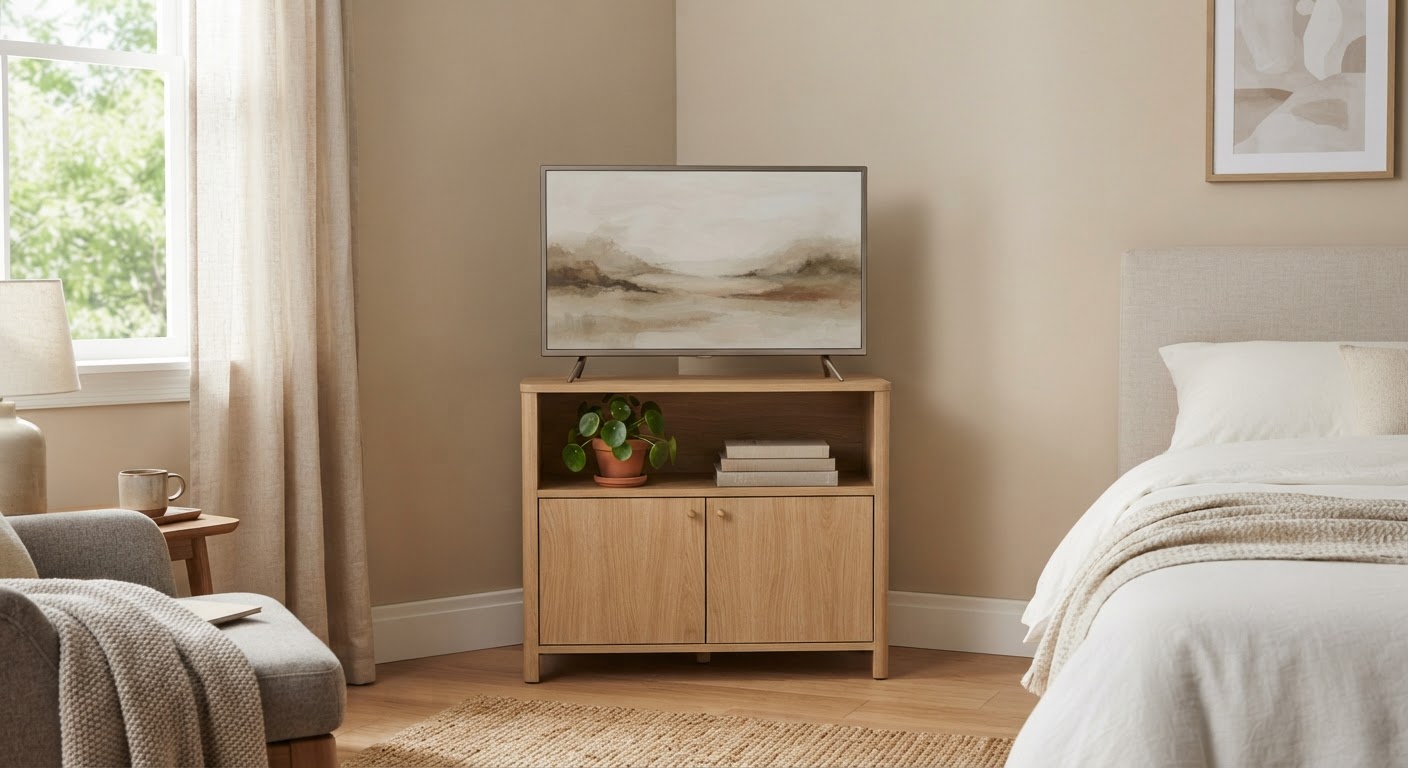
Small TV Stand: What Size TV Fits, How Wide It Should Be & How High
A small TV stand is a compact console, usually about 24 to 48 inches wide and often shallower than a living-room unit. Wayfair's small-space guide puts these stands under 48 inches long, and most products sold as "small TV stands" are rated for TVs from about 32 to 43 inches. These stands are made for bedrooms, apartments, dorms, kitchens and corners, where a full-size console won't fit.
On small stands the label is the least reliable number. "For TVs up to 32 inches" tells you nothing about whether your TV's feet will land on the top. A stand only 24 inches wide can't hold most 32-inch TVs, and a stand that sits low puts a small screen well below eye level. This guide covers three checks: width against your TV's real feet span, depth, and height, using measured TVs from the tv-sizes database.
Quick answers
| Question | Short answer |
|---|---|
| What counts as a small TV stand? | Roughly 24-48 inches wide. Wayfair's small-space guide puts the cutoff at under 48 inches. |
| What size TV goes on a small stand? | Usually 24 to 43 inches. A 50-inch TV needs a top of about 44 inches or more. |
| How wide should a small TV stand be? | At least 2 inches wider than your TV's feet span. Ideally it's also at least as wide as the TV itself. |
| Can the TV be wider than the stand? | Yes, as long as both feet sit fully on the top and the stand is stable and anchored. |
| How deep should it be? | Deep enough for the TV's feet or pedestal front to back. Small stands we found ranged from about 11.8 to 15.8 inches deep. |
| How tall should it be? | Taller than you might expect. With a sofa, a 32-inch TV needs a top near 31 inches to center the screen at about 42 inches. |
Step 1: Match the stand width to your TV's feet, not the label
The feet decide whether a TV fits a stand. The label doesn't. Here is what the measured models in our database show for the sizes most people put on a small stand:
| TV class | Theoretical 16:9 screen width | Real chassis width | Feet width range | Typical feet width (median) | Minimum top width | Comfortable top width |
|---|---|---|---|---|---|---|
| 24" | 20.9" | 22-24" | 9-20" | 12" | 22" | 24"+ |
| 32" | 27.9" | 29-31" | 14-29" | 24" | 31" | 32"+ |
| 40" | 34.9" | 36-37" | 15-34" | 30" | 36" | 38"+ |
| 43" | 37.5" | 38-39" | 22-35" | 30" | 37" | 40"+ |
| 50" | 43.6" | 44-45" | 25-40" | 38" | 42" | 46"+ |
How to read the table:
- Theoretical 16:9 screen width is the width of the picture area, calculated from the diagonal. It is not a real TV measurement.
- Real chassis width and feet width come from measured models in the tv-sizes TV database. We use only models whose records are internally consistent.
- Minimum top width is the widest feet span in the class plus 2 inches, so even the widest-footed model has about an inch of margin on each side.
- Comfortable top width is roughly the chassis width or a little more, so the screen doesn't overhang.
How many real TVs fit each stand width
We ran every consistent record in each class against common small-stand widths. A TV "fits" here when its feet span is at least 2 inches narrower than the top.
| Stand top width | 24" TVs | 32" TVs | 40" TVs | 43" TVs | 50" TVs |
|---|---|---|---|---|---|
| 24" | 13 of 13 | 3 of 16 | 2 of 10 | 1 of 16 | 0 of 12 |
| 32" | 13 of 13 | 16 of 16 | 7 of 10 | 8 of 16 | 2 of 12 |
| 36" | 13 of 13 | 16 of 16 | 10 of 10 | 13 of 16 | 5 of 12 |
| 40" | 13 of 13 | 16 of 16 | 10 of 10 | 16 of 16 | 7 of 12 |
| 44" | 13 of 13 | 16 of 16 | 10 of 10 | 16 of 16 | 12 of 12 |
Some patterns stand out:
- A 24-inch-wide riser is really a 24-inch-TV stand. Only 3 of 16 measured 32-inch TVs, the ones with narrow or center feet, have room on it. Buyer reviews of the 23.8-inch-wide Furinno riser describe the same problem: 32-inch TVs with wide-set legs hanging off the edges.
- A 32-inch-wide stand is the safe pick for any 32-inch TV, and it also takes about half of the 43-inch TVs.
- About 40 inches is the comfortable width for a 43-inch TV. Every measured 43-inch model fits, and the screen doesn't overhang.
- A 50-inch TV needs about 44 inches. By then you are at the top of the "small" range. If that's your TV, see our guide to wider consoles for how widths scale.
Real examples at both ends of each size
| TV | Class | Chassis width | Feet width | What it needs |
|---|---|---|---|---|
| Samsung UN24M4500 | 24" | 22" | 11" | Fits even a 24" riser with room to spare |
| Proscan PLEDV2488A-E | 24" | 22" | 20" | 22" minimum; a 24" top is fine |
| Westinghouse DWM32H1G1 | 32" | 29" | 17" | Fits a 24" top, with the screen overhanging about 2.5" per side |
| Samsung UN32J4002 | 32" | 31" | 29" | Needs about 31"; a 32" top is tight but works |
| Sony KDL40W650D | 40" | 36" | 15" | Fits a narrow top; check how deep the feet are |
| Sceptre U405CV-U | 40" | 36" | 34" | Needs about 36" |
| Sony KD43X720E | 43" | 38" | 22" | Fits a 24-32" top, but overhangs |
| LG 43UJ6300 | 43" | 39" | 35" | Needs about 37"; 40" is comfortable |
| Sony KD50X690E | 50" | 45" | 26" | Fits a 32" top, with a wide overhang |
| VIZIO D50-E1 | 50" | 45" | 40" | Needs about 42"; 46" is comfortable |
Browse more measured models in the 24-inch, 32-inch, 40-inch, 43-inch and 50-inch archives. If you already have a TV, measure from the outside edge of one foot to the outside edge of the other. Your own measurement beats any table.
Fit calculator
Measure the furniture.
We’ll size the screen.
Enter the clear inside width of your cabinet and the usable width of its base.
Overhang: when a narrower stand is fine
A screen wider than the stand is normal and safe when:
- both feet sit fully on the top, front to back and side to side,
- the stand is level and anchored, and
- nothing hangs below the screen edge where it could be knocked.
Overhang becomes a problem when the stand is light and tall, or when people walk past the stand and could catch a corner of the screen. A center-pedestal TV, or one with feet that can be set closer together, is the best match for a very narrow stand. Some TVs have a second, inner position for the feet. Check your TV's manual to see if yours does. Our database records one feet span per model.
Step 2: Check the depth
Small stands save space mostly by being shallow. The listings we found ran from about 11.8 inches (slim fluted consoles) to 15.8 inches (Furinno's tube-frame stands). Before you buy:
- Feet or pedestal depth. The TV's feet must sit fully on the top from front to back. Our database records feet width but not feet depth, so check your TV's spec sheet for "dimensions with stand", which includes depth.
- Soundbar room. A soundbar in front of the TV's feet often needs another 3-4 inches. On an 11.8-inch top, there may not be space for both.
- Cable clearance. Plugs sticking out of the back of the TV need space. On a shallow stand pushed against the wall, side-facing ports help.
If depth is tight, a wall-mounted TV with a shallow console below it frees the whole top. See our floating TV stand and floating TV shelf guides.
Step 3: Get the height right (small TVs need taller stands)
This step is easy to get wrong. A smaller screen is shorter, so its center sits lower on the same stand. To keep the middle of the picture near seated eye level, a small TV needs a taller stand than a big one.
Use: Stand top height = target screen center − half the screen height − gap below the screen
The gap is the distance from the stand top to the bottom edge of the screen when the TV stands on its feet. It is often about 2-4 inches. The tables below use 3 inches. Screen heights are theoretical 16:9 values, not chassis measurements.
| TV class | Screen height (theoretical) | Top height for sofa (42" center) | Top height for a raised bed (50" center) |
|---|---|---|---|
| 24" | 11.8" | 33.1" | 41.1" |
| 32" | 15.7" | 31.2" | 39.2" |
| 40" | 19.6" | 29.2" | 37.2" |
| 43" | 21.1" | 28.5" | 36.5" |
| 50" | 24.5" | 26.7" | 34.7" |
Now compare that with what small stands actually measure. The products we looked at are mostly about 20-23 inches tall, and the 2-tier riser is just 11 inches:
| TV class | Screen center on an 11" riser | on a 20" stand | on a 23.3" stand |
|---|---|---|---|
| 24" | 19.9" | 28.9" | 32.2" |
| 32" | 21.8" | 30.8" | 34.1" |
| 40" | 23.8" | 32.8" | 36.1" |
| 43" | 24.5" | 33.5" | 36.8" |
| 50" | 26.3" | 35.3" | 38.6" |
So a typical small stand puts a small TV's screen center roughly 4 to 13 inches below a 42-inch sofa eye height. That is fine for floor seating, a gaming chair or a low sofa, and it is often what people choose anyway. But if you watch from a regular sofa or bed:
- Look for a taller small stand, around 28-33 inches, or a narrow highboy. Our tall TV stand guide covers those.
- An 11-inch riser is designed to sit on top of a dresser, desk or counter. On a 30-inch dresser it puts a 32-inch TV's screen center near 52 inches, which suits a high bed.
- Or wall-mount the TV at the right height and use the small stand only for storage.
Measure your own eye height from where you sit. Typical seated figures are about 40-42 inches for a sofa, and higher for a bed. Then use the formula.
Step 4: Weight, stability and anchoring
Small stands are light, and light furniture tips more easily.
- Use the listed weight rating, and check it carefully. Ratings on small stands vary a lot. Even listings for the same Furinno riser give different top-shelf limits (20, 40 and 50 lb on different retailer pages), so use the figure for the exact version you buy and compare it with your TV's weight on its spec sheet.
- Anchor it. The U.S. Consumer Product Safety Commission advises securing TVs and furniture to the wall, and putting TVs only on furniture designed to hold one. Installation guidance is on the CPSC's Anchor It site. A small, light stand with a TV on top is the kind of setup that tip-over warnings are about. The CPSC reports an average of 17,800 tip-over injuries a year treated in emergency departments in 2020-2022.
- Keep heavy gear low. Put consoles and receivers on the bottom shelf, not on the top next to the TV.
- Don't use a nightstand or side table unless it is rated for a TV. Many are sized like small TV stands but were never designed to carry one.
Where small stands work, and the alternatives
| Space | What to look for | Alternative |
|---|---|---|
| Bedroom, watching from the bed | Taller top, about 33-41" for 24-43" TVs, or a riser on a dresser | Tall TV stand |
| Corner of a small room | Top wide enough for the feet, and a footprint that fits the corner | Corner TV stand |
| Studio or apartment living area | 32-40" wide, shallow depth, closed storage | Floating TV console |
| Shared or moveable TV | Wheels, height adjustment | Rolling TV stand |
| TV is wider than any stand that fits | Universal tabletop legs or a pedestal on a narrow surface, or a wall mount | Floating TV stand |
Example small TV stands
These are real products listed on amazon.com, chosen to cover the width bands above, from a 24-inch riser to a 43-inch console, plus a set of universal legs. Dimensions and TV-size claims come from the listing text as indexed when we researched this page. Where noted, they come from another retailer's listing for the same product line. We could not open the live listings and have not tested these stands, so confirm the current specifications before buying. These are affiliate links, and tv-sizes.com may earn a commission from qualifying purchases.
| Stand | Listed W x D x H | Listed TV size | How it fits the guidance | Link |
|---|---|---|---|---|
| Furinno Turn-N-Tube 2-Tier TV Riser (Espresso) | 23.8" x 15.8" x 11" | Up to 32" | A 24-inch-class stand: fits every measured 24" TV, but only 32" TVs with feet of about 22" or less. Its 11" height suits a dresser or desk top. | Check price on Amazon |
| Furinno Turn-N-Tube 3-Tier No Tools Entertainment Center (White) | About 31.5" x 15.8" x 23.3" (size per Zoro's listing for the 13192 series) | Up to 32" | Fits all 16 measured 32" TVs, although the 29"-feet Samsung UN32J4002 is tight. Puts a 32" screen center near 34". | Check price on Amazon |
| WLIVE Small TV Stand for 32 Inch TV (Rustic Brown) | 32.28" x 15.55" x 20.08" | 32" | Closed-cabinet option at the 32" width. The 110 lb tabletop rating comes from the product manual, not the Amazon listing. | Check price on Amazon |
| Small TV Stand for Bedroom, Low Fluted TV Console for 40/43 Inch (Walnut) | 39.4" x 11.8" x 19.7" | 32", 40", 43" | Wide enough for every measured 40" and 43" TV, but only 11.8" deep, so check your TV's feet depth. | Check price on Amazon |
| IANUE 43 inch TV Stand (Black) | 43.3" x 13.8" x 22.8" | Up to 50" | At the top of the small range. Fits every measured 50" model, since the widest feet in our data are 40". | Check price on Amazon |
| ELIVED Universal TV Stand Legs (YD2005) | Not listed | 32-55" | Replaces wide-set feet with a center base that needs a smaller footprint. Listed for up to 88 lb and VESA 200x100 to 800x400 mm. Check your TV's VESA pattern. | Check price on Amazon |
Compatibility chart by TV size
| TV class | Smallest top that fits every measured model | Comfortable top width | Sofa top height (42" center) | Small-stand verdict |
|---|---|---|---|---|
| 24" | 22" | 24"+ | about 33" | Ideal. Any small stand or riser works |
| 32" | 31" | 32"+ | about 31" | Ideal. Choose a 32"-wide top over a 24" riser |
| 40" | 36" | 38"+ | about 29" | Good. Look for a 36-40" top |
| 43" | 37" | 40"+ | about 28.5" | Good. About 40" is the sweet spot |
| 50" | 42" | 46"+ | about 27" | The upper limit of "small". Look for 44"+ |
| 55" and larger | 48"+ | 50"+ | — | Not a small-stand TV. See the 65 inch and 75 inch stand guides |
To compare how width, height and area grow between sizes, use the TV screen size comparison or the TV size calculator. For seating distance in a small room, see the viewing distance guide.
Viewing distance
How far is your seat?
Use this as a practical starting point, then adjust for your room and preferences.
- Mixed viewing
- 60″
- Cinema / 4K
- 80″
FAQ
What size TV fits on a small TV stand?
Most small stands suit 24- to 43-inch TVs. What decides it is your TV's feet span. Measured 32-inch TVs have feet from 14 to 29 inches apart, and 43-inch TVs from 22 to 35 inches. Add about 2 inches to your TV's feet span to get the narrowest top that works.
Will a 32 inch TV fit on a 24 inch stand?
Only if its feet are close together. In our database just 3 of 16 consistent 32-inch records have feet narrow enough, about 22 inches or less, for a 24-inch top. Most need a stand at least 31-32 inches wide.
What size stand do I need for a 43 inch TV?
A top of at least 37 inches covers every 43-inch model we've measured, and about 40 inches keeps the 38-39 inch chassis from overhanging.
Can a TV be wider than its stand?
Yes. The screen can overhang as long as both feet sit fully on the top and the stand is anchored. Avoid big overhangs on light, tall stands and in walkways.
How tall should a small TV stand be?
Taller than most are. For a sofa with a 42-inch eye height, a 32-inch TV wants a top of about 31 inches and a 43-inch TV about 28.5 inches. Most small stands are 20-23 inches tall, so the screen will sit lower than that.
Is a nightstand OK as a small TV stand?
Only if the maker says it can carry a TV. Otherwise use a stand built for TVs and anchor both the stand and the TV.
Related guides on tv-sizes.com
- Tall TV stand, corner TV stand, rolling TV stand and floating TV stand for other stand types in small rooms
- TV stand for a 65 inch TV for how width rules scale up
- Small TVs in our database and the full TV database
Bottom line
Choose a small TV stand by three measurements, not by the "up to 32 inches" label. The top should be at least 2 inches wider than your TV's feet span: about 32 inches for a 32-inch TV, and about 40 inches for a 43-inch TV. The top should also be deep enough for the feet. And check the height, because small TVs on low stands sit well below sofa eye level. Then anchor the stand and the TV.
As an Amazon Associate we earn from qualifying purchases. Price and availability can change.