
TV-Sizes journal
Tall TV Stand: How High It Should Be, What TV Fits & How to Keep It Stable
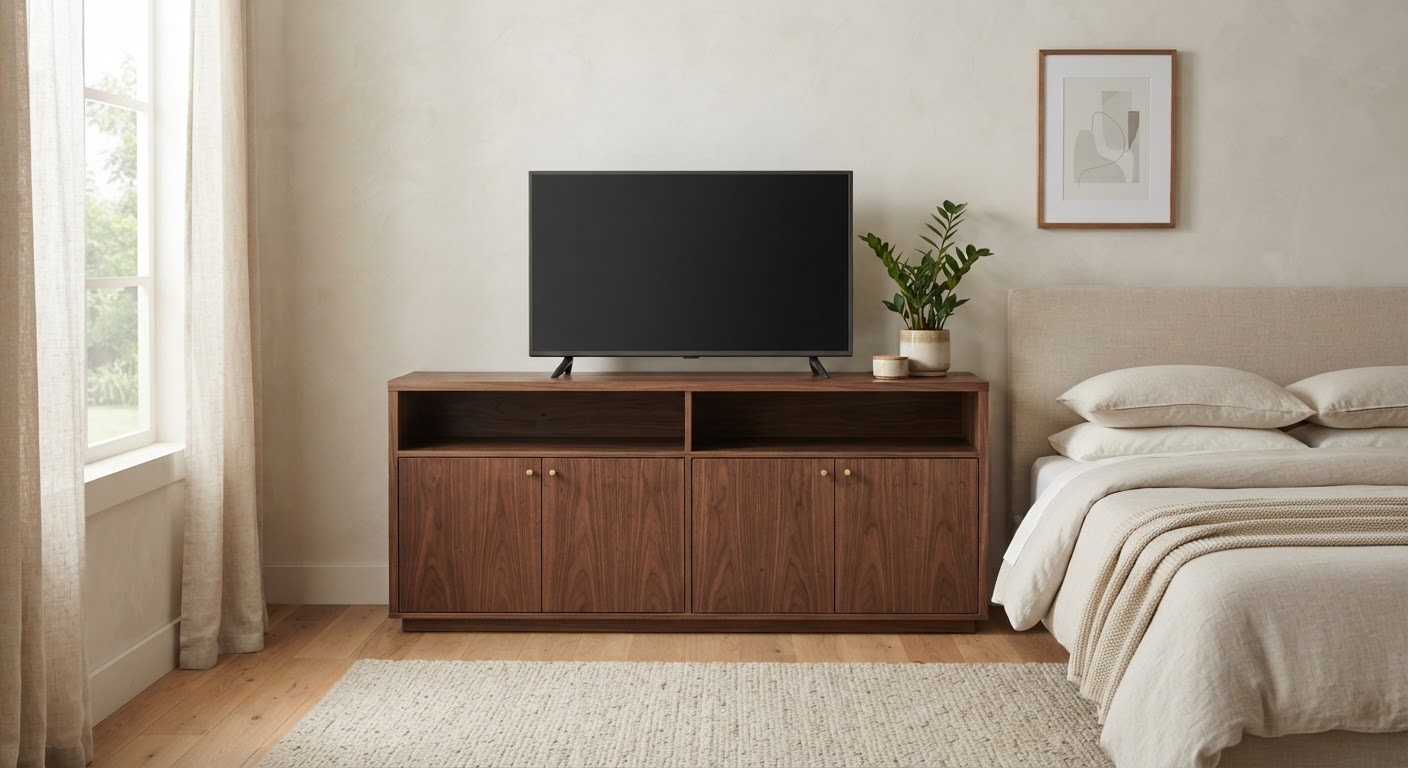
Tall TV Stand: How High It Should Be, What TV Fits & How to Keep It Stable
A tall TV stand is a console or highboy with a top surface above the usual sofa-height range. Retail guides generally call anything over about 32 inches tall, and the products we found sold under the name mostly land between 32 and 40 inches. There is no formal standard. What matters is where the stand puts the center of your screen, because that number changes with the size of the TV.
Here is the part most buying guides skip: a tall stand plus a big TV can put the screen too high very quickly. On a 36-inch stand, a 65-inch TV has its screen center near 55 inches off the floor. That is well above sofa eye level, but it can suit a high bed or a bar stool. This guide shows you how to work out the right height for your seat and TV, check the width against your TV's feet, and keep a taller, top-heavier piece of furniture from tipping.
Quick answers
| Question | Short answer |
|---|---|
| How tall is a tall TV stand? | Usually over about 32 inches, with the products we found mostly between 32 and 40 inches. Standard consoles run about 21-32 inches. |
| Who actually needs one? | People watching from a raised bed, bar stools or counter seating, or while standing. A smaller TV on a sofa can also need a taller stand. |
| Can I use a tall stand with a sofa? | Only with small TVs. At a 42-inch screen center, a 55-inch TV wants a top near 25.5 inches, and a 65-inch TV wants about 23 inches. |
| What TV size fits? | Check the top width against your TV's feet span. The "up to 55 inches" line on a listing does not tell you whether the feet land on the top. |
| How do I work out the height? | Target screen center, minus half the screen height, minus the gap between the stand top and the bottom of the screen. |
| Are tall TV stands safe? | Anchor the stand and the TV to the wall. The CPSC's fallback advice for TVs that cannot be anchored is a sturdy, low base, which a tall stand is not. |
What counts as "tall"
| Category | Top height | Typical use |
|---|---|---|
| Low profile | Under about 21" | Wall-mounted TVs above, low seating |
| Standard | About 21-32" | Most sofas and armchairs |
| Tall / highboy | Over about 32" | High beds, bar stools, counter seating, standing viewing |
These bands come from retail buying guides and vary a little between them. Some put tall at 30-40 inches, and one roundup used 34 inches as its minimum. Measure the piece you are considering instead of relying on the label. "Highboy" in a product title is a style word, and we found listings using it at both 32 and 39 inches.
How to work out the right height
Use this formula, then check the result against the tables below:
Stand top height = target screen center − half the screen height − gap below the screen
- Find your target screen center. Sit where you normally watch and have someone measure from the floor to your eyes. For a bed, sit propped up the way you really watch. Typical figures are about 40-42 inches for a sofa and up to about 50 inches for a raised bed, but your own measurement beats any average.
- Find half the screen height. Use the table below, or measure your own screen.
- Find the gap below the screen. This is the distance from the stand top to the bottom edge of the screen when the TV is on its feet. It is commonly about 2-4 inches, and it varies by model. The tables here assume 3 inches. Measure your TV if you already own it.
Stand top height for each TV size
The first two columns are theoretical 16:9 screen dimensions, not chassis measurements.
| TV class | Screen height (theoretical) | Half height | Sofa (42" center) | High bed (50" center) | Counter or bar seating (58" center) |
|---|---|---|---|---|---|
| 32" | 15.7" | 7.8" | 31.2" | 39.2" | 47.2" |
| 43" | 21.1" | 10.5" | 28.5" | 36.5" | 44.5" |
| 50" | 24.5" | 12.3" | 26.7" | 34.7" | 42.7" |
| 55" | 27.0" | 13.5" | 25.5" | 33.5" | 41.5" |
| 65" | 31.9" | 15.9" | 23.1" | 31.1" | 39.1" |
| 75" | 36.8" | 18.4" | 20.6" | 28.6" | 36.6" |
| 85" | 41.7" | 20.8" | 18.2" | 26.2" | 34.2" |
Read across and the pattern is plain. For sofa viewing, a truly tall stand only suits TVs around 32 inches. For a high bed, tall stands suit roughly 43-55 inch TVs. For counter or bar seating, most sizes can use one. The 58-inch column is an estimate for someone on a counter or bar stool, so measure your own stools and your own eye height.
If you are thinking about a 65- or 75-inch TV in a living room, a standard console sized for a 65 inch TV or 75 inch TV will almost always serve you better.
Screen center you get from a given stand
Already looking at a specific stand? This is the same math run the other way, again with theoretical 16:9 screen height and a 3-inch gap.
| TV class | 30" stand | 32" stand | 36" stand | 39" stand |
|---|---|---|---|---|
| 32" | 40.8" | 42.8" | 46.8" | 49.8" |
| 43" | 43.5" | 45.5" | 49.5" | 52.5" |
| 50" | 45.3" | 47.3" | 51.3" | 54.3" |
| 55" | 46.5" | 48.5" | 52.5" | 55.5" |
| 65" | 48.9" | 50.9" | 54.9" | 57.9" |
| 75" | 51.4" | 53.4" | 57.4" | 60.4" |
| 85" | 53.8" | 55.8" | 59.8" | 62.8" |
Bedrooms: the main reason to go tall
A low console at the foot of a bed has two problems: the screen sits below your line of sight and your feet or footboard can block the bottom of it. Check both:
- Eye height. Sit against your pillows and measure from the floor to your eyes. Use that as the target center in the table above.
- Bottom edge. The lower edge of the screen sits at the stand height plus the gap under the screen, and on a given stand that figure stays the same whatever the TV size. A 30-inch stand with a 3-inch gap puts the bottom edge at about 33 inches. It needs to clear the top of your footboard and, ideally, your feet under the covers.
Published bedroom height recommendations vary widely, from about 30 to 54 inches depending on the source. That spread is one more reason to measure your own bed. A low platform bed and a high pillow-top can put your eyes at very different heights.
Also check how far you will sit from the screen. A bedroom is often shorter than a living room, so a smaller TV on a taller stand can be the better layout. Use the calculator below, or read the viewing distance guide.
Viewing distance
How far is your seat?
Use this as a practical starting point, then adjust for your room and preferences.
- Mixed viewing
- 60″
- Cinema / 4K
- 80″
Check the width against your TV's feet
Many tall stands are narrow: the highboys we found start at about 36 inches wide. That makes the feet check especially important. The top has to be wider than the outer edges of your TV's feet, with a couple of inches to spare.
Measured models from the tv-sizes database show why a screen size alone is not enough:
| TV class | Real chassis width | Feet width range | Typical feet width (median) |
|---|---|---|---|
| 32" | 29-31" | 14-29" | 24" |
| 43" | 38-39" | 22-35" | 30" |
| 50" | 44-45" | 25-40" | 38" |
| 55" | 48-49" | 17-46" | 38" |
| 65" | 57-58" | 17-56" | 38" |
| 75" | 66-67" | 17-61" | 46" |
The range is from the models in each class whose records are internally consistent. Here are some specific examples at each end of the range:
| TV | Class | Chassis width | Feet width | Top width it needs |
|---|---|---|---|---|
| Sony KD43X720E | 43" | 38" | 22" | Fits a 36" top; the screen overhangs slightly |
| LG 43UJ6300 | 43" | 39" | 35" | Tight on 36"; go 38" or wider |
| Sceptre X505BV-F | 50" | 45" | 25" | Fits a 36" top; the screen overhangs |
| VIZIO D50-E1 | 50" | 45" | 40" | Needs about 42" or wider |
| LG OLED55E7P | 55" | 49" | 17" | Center stand; check the base depth |
| TCL 55C807 | 55" | 49" | 46" | Needs about 48" or wider |
| Sony XBR65Z9D | 65" | 58" | 17" | Center stand; check the base depth |
| TCL 65C807 | 65" | 57" | 56" | Needs about 58" or wider |
| VIZIO M75-E1 | 75" | 67" | 61" | Needs about 63" or wider |
Feet width is the fit test, and chassis width is the appearance test. A screen can overhang a narrow top and still be supported, as long as the feet sit fully on the surface and the stand is anchored. But a tall stand with a wide overhang looks top-heavy, and it can be. Where you can, choose a top at least as wide as the TV chassis. Browse more measured models in the 43-inch, 55-inch and 65-inch archives or search the TV database.
Fit calculator
Measure the furniture.
We’ll size the screen.
Enter the clear inside width of your cabinet and the usable width of its base.
Depth, load and stability
Taller furniture has a higher center of gravity, and a TV on top raises it further. The listings we checked were commonly about 15-16 inches deep. A 36-inch-tall stand at 15.75 inches deep is about 2.3 times as tall as it is deep, before the TV goes on. So treat these checks as required:
- Feet depth. Make sure the TV's feet, or the base of a center stand, sit fully on the top from front to back. Our database records feet width but not feet depth, so check your TV's spec sheet.
- Weight rating. Compare the stand's listed limit with your TV's weight from the spec sheet. Listings can disagree across colorways or between the title and the bullets, so confirm the figure for the exact version you buy. Some listings give no TV weight limit at all.
- Put weight low. Keep heavier items, such as a receiver or games, on the lower shelves. The CPSC also advises keeping tempting items like toys and remotes off higher shelves.
- Level the base. Use the adjustable feet if the stand has them, and take care on thick carpet, where a tall piece can lean.
- Anchor the stand and the TV. The CPSC says TVs and furniture should be secured to the wall, and it recommends putting TVs only on furniture designed to hold one. Where anchoring is impossible, its fallback is a sturdy, low base with the TV pushed back as far as possible, and cords kept out of reach. A tall stand does not meet that fallback, so it should be anchored.
That is more than a formality. The CPSC's most recent reported figures show an average of 17,800 emergency-department-treated tip-over injuries a year from 2020 to 2022, with 44 percent of the victims under 18. Installation steps are on the CPSC's Anchor It site. The federal STURDY Act stability rule covers clothing storage furniture like dressers, not TV stands, so a TV stand's marketing does not tell you it passed that test.
A dresser is a common stand-in for a tall TV stand in bedrooms. It may be the right height, but it was not designed to carry a TV, so it is the wrong tool unless the maker says otherwise.
Cable and gear planning
A tall stand gives you more shelves, but also a longer run from the wall outlet to the top.
- Check the power cord and HDMI lengths. Cables that fit a 24-inch stand may fall short at 36 or 40 inches.
- Look for a cable pass-through or an open back. A soundbar on the top needs to sit in front of the TV without blocking the screen or the remote sensor, and a 2-4 inch gap under the screen leaves little room.
- If a soundbar will not fit, a shelf below the top usually works, though the sound will come from lower than the screen.
- Open shelves let consoles and receivers breathe. Enclosed cabinets need vent paths.
When a tall stand is the wrong answer
| Situation | Better option |
|---|---|
| Main living-room sofa with a 55-inch or larger TV | A standard console, or a floating TV stand mounted at the right height |
| Need adjustable height or to move the TV between rooms | A rolling TV stand |
| Corner placement | A corner TV stand |
| Above a fireplace | Our fireplace TV stand guide covers height and heat |
| Very large TV, 85 inches or more | A long, appropriately wide console. The widest tall stands we found were about 71 inches, narrower than the 76-inch chassis of the one 85-inch model in our database. |
Example tall TV stands
These are real products listed on amazon.com, chosen to show the range of heights and widths discussed above. Dimensions and TV-size claims come from the listing text as indexed when we researched this page, and where noted, from another retailer's listing for the same product. We were not able to open the live listings, and we have not tested any of these stands. Confirm the current specification and availability before buying. These are affiliate links, and tv-sizes.com may earn a commission from qualifying purchases.
| Stand | Listed W x D x H | Listed TV size | How it fits the guidance | Link |
|---|---|---|---|---|
| Convenience Concepts Big Sur Highboy | 36" x 15.75" x 36" (dimensions per Walmart's listing for the same product) | Up to 40" | With a 40-inch TV, screen center lands near 49". Suits a raised bed. Check that your TV's feet fit a 36" top. | Check price on Amazon |
| Convenience Concepts Designs2Go XL Highboy 4-Tier | 47.25" x 15.75" x 36.25" | Up to 55" | With a 50-inch TV, screen center is about 51.5". A 55-inch TV with 46" feet would leave almost no margin on this top. | Check price on Amazon |
| WAMPAT 3-in-1 Tall Highboy Entertainment Center | 70.8" x 15.35" x 32.4" | Up to 75"+ | At the low end of "tall". A 55-inch TV centers near 49", and a 65-inch TV near 51". Wide enough for the VIZIO M75-E1's 61" feet. | Check price on Amazon |
| IFGET Farmhouse 39" Tall Highboy | 70" x 20" x 39.25" | Up to 80" | Puts a 65-inch TV's screen center near 58", so it suits bar or counter seating more than a sofa. We found no listed weight rating. | Check price on Amazon |
Compatibility by TV size
| TV class | Tall stand for sofa? | For a high bed? | For bar or counter seating? | Minimum top to check |
|---|---|---|---|---|
| 32" | Yes, about 31" | Yes, about 39" | Yes, about 47" | Your feet span, typically 24" |
| 43" | Rarely | Yes, about 36" | Yes, about 44" | 22-35" feet span |
| 50" | No | Yes, about 35" | Yes, about 43" | 25-40" feet span |
| 55" | No | Yes, about 33" | Yes, about 41" | 17-46" feet span |
| 65" | No | Marginal, about 31" | Yes, about 39" | 17-56" feet span |
| 75" | No | No, under 29" | Yes, about 37" | 17-61" feet span |
| 85" | No | No | Marginal, about 34" | Measure; very few models in our data |
To see how width, height and area scale between sizes, use the TV screen size comparison or the TV size calculator.
FAQ
What is the standard height of a tall TV stand?
There is no standard. Retail guides usually treat anything over about 32 inches as tall, and the products we found sold that way are mostly 32-40 inches high.
How tall should a TV stand be for a bedroom?
Take your eye height while propped up in bed, then subtract half the screen height and the gap under the screen. For a 50-inch center and a 3-inch gap, that is about 36.5 inches for a 43-inch TV, 33.5 inches for a 55-inch TV and 31 inches for a 65-inch TV.
What size TV goes on a 36 inch tall stand?
Height does not limit the TV size. The top width and your viewing position do. On a 36-inch stand, a 43-inch TV centers near 49.5 inches, which suits a bed. A 65-inch TV centers near 55 inches, which suits bar seating and sits high for a sofa.
Can a TV be wider than a tall stand?
The screen can overhang as long as the feet sit fully on the top and the stand is anchored. Keep the overhang modest, because it makes a tall stand look and act more top-heavy.
Is a highboy TV stand the same as a tall TV stand?
Mostly yes. "Highboy" is a style word that retailers use for taller consoles, but the listed heights vary. Check the actual height on the listing.
Do tall TV stands tip over easily?
A taller piece of furniture is less stable than a low one, and a TV on top makes that worse. Anchor the stand and the TV to the wall, keep heavy items on the lower shelves, and do not stack things children might climb for.
Related guides on tv-sizes.com
- TV stand for a 65 inch TV, 75 inch TV and 85 inch TV for width math by size
- Floating TV stand, corner TV stand, fireplace TV stand and rolling TV stand for the other stand types
- TV size calculator and the full TV database
Bottom line
Choose a tall TV stand by where it puts the screen, not by how tall it looks. Start with your eye height, subtract half the screen height and the gap under the screen, and you have the top height you need. Then check the top width against your TV's real feet span. Tall stands make the most sense for high beds and bar seating, and for small TVs. Whatever you choose, anchor it.
As an Amazon Associate we earn from qualifying purchases. Price and availability can change.