
TV-Sizes journal
Floating TV Cabinet: How Wide, Deep and High Should It Be?
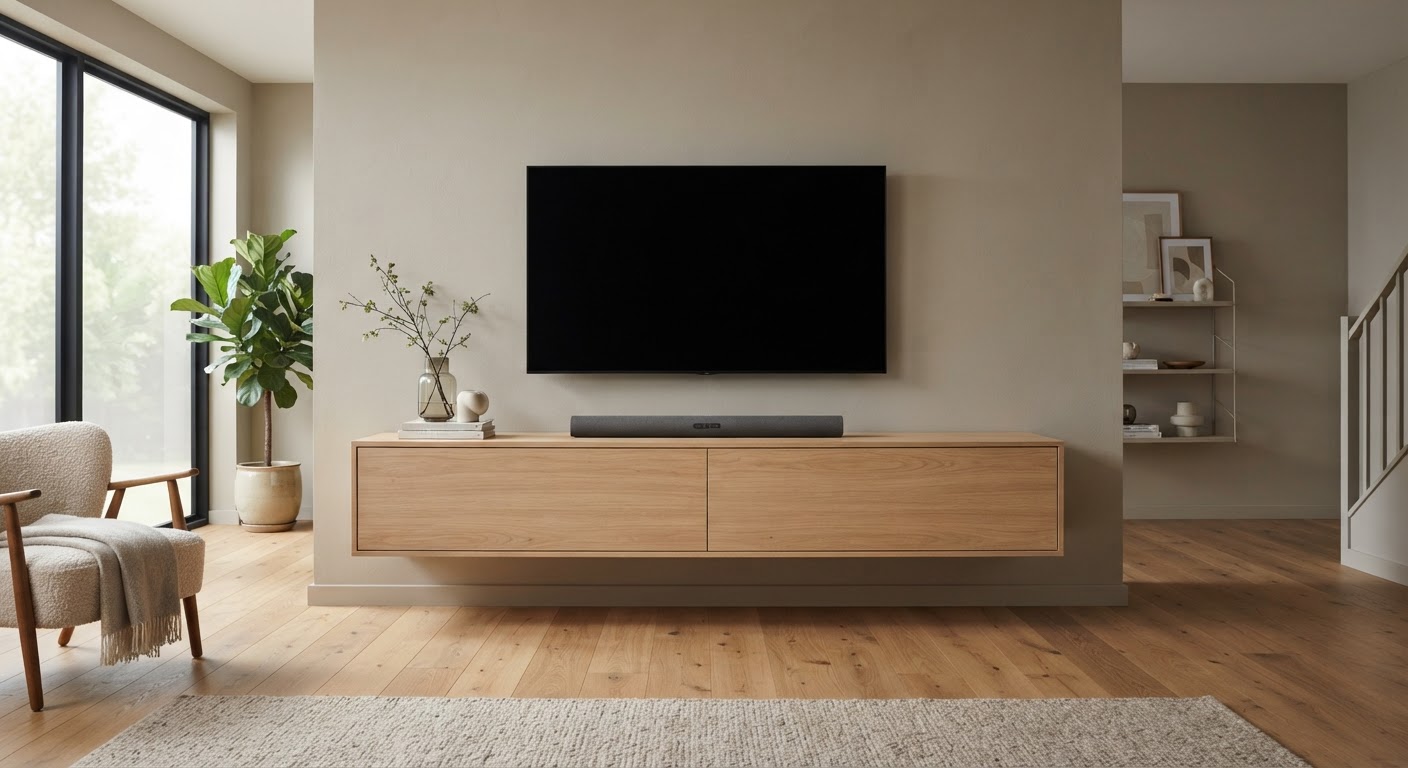
Floating TV Cabinet: How Wide, Deep and High Should It Be?
A floating TV cabinet — often called a floating TV unit in the UK, Ireland, Australia and New Zealand — is a wall-hung media cabinet that leaves the floor clear beneath it. The name covers a much wider spread of products than most shoppers expect: from a slim 24 cm-deep shelf-cabinet that holds a soundbar and a router, to a 40 cm-deep unit that swallows a full-size AV receiver.
Because nothing touches the floor, three dimensions decide whether a floating cabinet works, and each one answers to something different:
- Width is about your TV (and, if the TV sits on top, its feet).
- Depth is about the gear you store inside.
- Height is about your eyes.
A fourth factor decides whether it stays on the wall at all: the fixing. This guide covers all four using real cabinet dimensions from current listings and real, measured TV widths from the tv-sizes database.
Quick answers
| Question | Short answer |
|---|---|
| How wide should a floating TV cabinet be? | At least as wide as the TV's real chassis; 15–30 cm (6–12 in) wider looks balanced. If the TV sits on the cabinet, never narrower than the outer edge of its feet. |
| How deep should it be? | 20–25 cm for a soundbar, streaming stick and router; 28–32 cm for a cable box or a game console with vent space; 35–40 cm if you want an AV receiver. Add 2–5 cm behind for plugs and cable bends. |
| How high off the floor? | Set the screen centre near seated eye level (about 100–110 cm / 40–44 in), then leave a 15–25 cm (6–10 in) gap under a wall-mounted TV. That usually puts the cabinet top 40–65 cm off the floor for 43–65 in screens, and lower for larger ones. |
| Can the TV stand on the cabinet? | Only if the feet fit fully on the top surface and the unit is rated for the combined weight. Most floating cabinets are designed to hang under a separately wall-mounted TV. |
| Will it stay up? | Only with the right fixings. Real listings explicitly exclude plasterboard, drywall, hollow wall and gypsum board — a floating cabinet belongs on studs, brick or concrete. |
| Is there a "standard" height? | No single standard exists. Work backwards from eye level and the gap you want, then choose the cabinet top height — not the other way round. |
Floating TV cabinet, unit, console or stand?
Retailers use the words almost interchangeably, which makes sizing advice hard to apply. On this site the four products are separated like this:
| Product | Typical depth | Structure | Main job |
|---|---|---|---|
| Floating TV shelf | 15–25 cm | One open slab or a small unit | Hold a soundbar or a couple of small boxes |
| Floating TV stand | 20–30 cm | Open frame or slim cabinet | Hold gear and sometimes carry the TV on top |
| Floating TV console | 28–45 cm | Enclosed cabinet with doors or drawers | House components out of sight under a wall-mounted TV |
| Floating TV cabinet / unit | 20–40 cm | Wall-hung enclosed cabinet, often modular | The UK/Commonwealth name for the same storage-first idea |
In practice, "floating TV cabinet" and "floating TV unit" describe the same object: a wall-hung box with doors, drawers or an open bay. The difference from a floating TV stand is mostly depth and enclosure, and the difference from a floating TV console is mostly vocabulary and the metric sizing that goes with it.
Width: how wide should a floating TV cabinet be?
There are two arrangements, and they use different arithmetic.
The TV is wall-mounted above the cabinet. The cabinet carries no screen, so width is a proportion choice. Start at roughly the TV's own width and add 15–30 cm (6–12 in) so the cabinet overhangs the screen slightly on each side and reads as deliberate rather than as a sliver.
The TV sits on top of the cabinet. Now the cabinet is a TV stand, and the hard constraint is the feet. TV feet come in two families: a centre pedestal (narrow — often 43–65 cm) or edge legs close to the corners (nearly the full chassis width). A centre pedestal can sit on a cabinet much narrower than the TV; edge legs need a cabinet essentially as wide as the chassis. Measure the outer edge of each foot before buying.
Cabinet width chart by TV size
The "65-inch" label is the screen diagonal, not the width. The table uses the theoretical 16:9 screen width (geometry only), the real chassis width measured in the tv-sizes database, and then builds cabinet-width bands on top of the real chassis width.
| TV class | Theoretical 16:9 screen width | Real chassis width (database) | Minimum cabinet | Balanced (TV + 15–30 cm) | Common cabinet size |
|---|---|---|---|---|---|
| 32" | 70.8 cm (27.9 in) | 74–79 cm (29–31 in) | 79 cm | 90–105 cm | 90–100 cm |
| 43" | 95.2 cm (37.5 in) | 97–99 cm (38–39 in) | 99 cm | 110–125 cm | 120 cm |
| 50" | 110.7 cm (43.6 in) | 112–114 cm (44–45 in) | 114 cm | 125–140 cm | 140 cm |
| 55" | 121.8 cm (47.9 in) | 122–124 cm (48–49 in) | 124 cm | 135–155 cm | 140–160 cm |
| 65" | 143.9 cm (56.7 in) | 145–147 cm (57–58 in) | 147 cm | 160–180 cm | 160–180 cm |
| 75" | 166.0 cm (65.4 in) | 168–170 cm (66–67 in) | 170 cm | 180–200 cm | 180–200 cm |
| 85" | 188.2 cm (74.1 in) | 193 cm (76 in) | 193 cm | 205–225 cm | 200–240 cm |
The theoretical column is 16:9 screen geometry calculated from the diagonal — not a chassis measurement. The chassis column is what the physical TV actually measures. Cabinet widths are design guidance, not standards.
Floating cabinets are commonly sold in round metric lengths: 120, 140, 160, 180, 200, 220 and 240 cm. The real UK-style families found during research go further, from 140 cm up to 300 cm (55.1 in to 118.1 in). That makes the mapping above easy to shop: a 55 in TV wants a 140–160 cm cabinet, a 65 in wants 160–180 cm and a 75 in wants 180–200 cm.
To test a specific cabinet against a specific TV, the site's fit calculator compares the two.
Fit calculator
Measure the furniture.
We’ll size the screen.
Enter the clear inside width of your cabinet and the usable width of its base.
Depth: 20, 25, 30 or 40 cm?
Depth is where the autocomplete questions cluster — floating tv unit 30cm depth, 20cm depth, 25cm depth, narrow depth floating tv unit — and it is the specification most buyers get wrong. A cabinet that is too shallow forces the receiver onto the floor or the door to stay ajar.
In metric terms the market splits into four useful bands:
| Cabinet depth | What actually fits | Watch out for |
|---|---|---|
| 20 cm (7.9 in) | Soundbar, streaming stick, Wi-Fi router, very slim set-top box, decorative items | Too shallow for a cable box standing upright or a game console with real vent space |
| 24–25 cm (9.4–9.8 in) | The most common slim floating-unit depth: streamers, routers, small set-top boxes, a soundbar on top | Still tight for an AV receiver; check rear clearance for plugs |
| 28–32 cm (11–12.6 in) | Cable box or DVR lying flat, game console with airflow, most small media gear | Receiver fits only if it is a compact model and the back is open |
| 35–40 cm (13.8–15.7 in) | AV receiver and full-size components, deeper boxes and cable slack | Adds bulk in the room; needs the most solid fixing |
Two rules apply at every depth:
- Cable and plug clearance. Allow 2–5 cm behind the unit for plug bodies and cable bends, and check whether the back panel is open, slotted or solid. A hollowed back or a grommet makes a floating cabinet far easier to live with.
- Ventilation. Enclosed cabinets trap heat. Give receivers and consoles a few centimetres of air on the sides and above, and prefer an open back or vent slots over a fully sealed box.
The doors themselves matter too. Sliding or flip-down doors need no swing room in front, which suits a walkway or a narrow room. Hinged doors and drawers project into the room and add a pull-out force at the top edge of the cabinet — relevant to the load section below.
Height: how high off the floor?
There is no single "standard" floating cabinet height, and any guide that gives one number is ignoring your TV size. The reliable method is to start from your eyes and work down:
- Pick a screen-centre height. About 100–110 cm (40–44 in) from the floor suits most people on a sofa; go slightly higher if you watch from a taller seat.
- Find the bottom edge of the screen:
screen centre − (screen height ÷ 2). - Subtract the gap you want between the TV and the cabinet. Under a wall-mounted TV, 15–25 cm (6–10 in) is the practical target — enough for airflow, plug access and a soundbar, without the cabinet drifting away from the screen.
The table applies that method with the screen centre at 107 cm (42 in) and theoretical 16:9 screen height.
| TV class | Theoretical screen height | Screen bottom at 107 cm centre | Cabinet top, TV wall-mounted above (15–25 cm gap) | Floor gap with a 20 cm-tall cabinet |
|---|---|---|---|---|
| 43" | 53.5 cm (21.1 in) | ~80 cm | 55–65 cm | 35–45 cm |
| 50" | 62.3 cm (24.5 in) | ~76 cm | 51–61 cm | 31–41 cm |
| 55" | 68.5 cm (27.0 in) | ~73 cm | 48–58 cm | 28–38 cm |
| 65" | 80.9 cm (31.9 in) | ~66 cm | 41–51 cm | 21–31 cm |
| 75" | 93.4 cm (36.8 in) | ~60 cm | 35–45 cm | 15–25 cm |
| 85" | 105.8 cm (41.7 in) | ~54 cm | 29–39 cm | 9–19 cm |
These heights come from theoretical screen geometry plus a stated eye-level assumption and gap — they are not manufacturer specifications. The takeaway is that a large screen pushes the cabinet down: by the time you reach 75–85 in, the cabinet top is usually 30–45 cm off the floor so the bottom of the screen is not too high. For 43–55 in screens, a top around 48–65 cm is typical.
If the TV sits on the cabinet instead of hanging above it, subtract the TV's own stand height from the screen bottom edge rather than a gap, and measure the stand — pedestal and leg heights vary.
If you sit closer than the recommended distance for your screen, your eyes look down more and the ideal screen centre drops slightly. Check your room with the viewing-distance guide or the calculator below before drilling.
Viewing distance
How far is your seat?
Use this as a practical starting point, then adjust for your room and preferences.
- Mixed viewing
- 60″
- Cinema / 4K
- 80″
Will it stay on the wall? Load, fixings and the failure mode
A floating cabinet has no legs, so every kilogram of cabinet, gear and (sometimes) television travels through its mounting rail and fasteners into the wall. That is the real engineering difference from a floor console, and it is exactly what the r/DIYUK thread titled "Floating tv cabinet just failed" is about.
Budget the load. Add the cabinet's own weight to everything you put in and on it. Real examples from current listings: the 140–300 cm Btsunotr cabinet family weighs about 15 kg and rates its hanging frame to 120 lb (≈54 kg), while the 71 in EXQUAL unit carries a 110 lb (≈50 kg) rating. Treat those as ceilings and stay comfortably under them — gear adds up faster than people expect.
Understand the lever. The cabinet's centre of mass sits roughly half its depth away from the wall, so a deeper cabinet pulls outward as well as down. Opening a drawer or a hinged door makes it worse, because the pull happens at the front edge. This is why a cabinet rated for the static weight can still work loose.
Fix into something solid. The Btsunotr listing states plainly that the unit is not applicable to dry wall, hollow wall or gypsum board wall, and the SZKTHD cabinet says it must be wall mounted on a solid wall. The available substrates:
- Timber stud walls: drive the rail fixings into the studs (or into a plywood pattress fixed across them). Drywall anchors alone are for pictures and lightweight shelves.
- Brick, block or concrete: use masonry anchors rated for the load.
- Plasterboard, drywall, hollow or gypsum walls: several floating cabinets exclude these entirely. If it is the only wall you have, fix a substantial batten or pattress into the structure behind it and mount to that.
- Metal studs and tiled walls: use rated fasteners and fix into the substrate, not the surface.
Use the supplied hardware as a minimum, not a maximum. Community failure reports usually come down to fixings — the wrong screw, too few of them, or anchors into plasterboard. Spread the rail across at least two studs where you can, and add fixings for heavy cabinets.
IKEA BESTA and the "floating TV cabinet hack"
IKEA's BESTA system is the most common starting point for a floating TV cabinet hack, because the frames are modular: the finished width is simply the sum of the modules you combine, and open bays can be mixed with door and drawer fronts. That modularity is also the trap.
A wall-hung BESTA-style combination relies on a suspension rail fixed to the wall, so the same rules as above apply: the rail must reach studs, masonry or a suitable pattress, and the whole combination — frames, fronts and contents — must stay within what the rail and fixings are rated to carry. Do not hang a floor-standing cabinet by its back panel and assume it will hold; that is the failure pattern behind most "floating TV cabinet failed" posts. Check the specific rail and fixing kit for the combination you build, and keep heavy components in the lower or central modules.
If you would rather not build a run, the sizing is identical to any other cabinet: match the module total to the width bands above.
Floating TV cabinet with a fireplace
A floating cabinet with an integrated electric fireplace is a growing variant of this search, and it adds three things to the normal sizing job:
- Weight. The firebox and its surround add mass to an already cantilevered unit, so the fixing must be even more solid.
- Heat. Electric fireplaces push warm air out and up. Keep the TV above the heat outlet, respect the fireplace's stated clearance to combustibles and to the TV, and never seal the firebox into a closed cabinet without ventilation.
- Depth and height. Fireplace units are typically deeper than slim cabinets, which changes the width bands only slightly but tightens the TV-to-cabinet gap. Leave more space so heat does not rise straight into the screen.
Real floating TV cabinets that fit common TV sizes
These are real wall-mounted cabinets found during research, with the dimensions and load figures from their listings. Use them as concrete examples of the widths and depths discussed above — and confirm current dimensions, capacity and wall-type requirements on the listing before buying.


A note on "fits up to 65 inch" claims. Listings describe TV compatibility by diagonal, but the cabinet only has to answer to the TV's real width. The 140 cm HOMMPA unit is listed for 65 in TVs, yet most 65 in chassis in the database measure 145–147 cm wide, so a 65 in screen will overhang it. That is perfectly normal for a wall-mounted TV above a low cabinet, but it shows why the diagonal is a poor guide: check the chassis width. The 180 cm examples match 65–75 in screens comfortably.
Real TVs: the widths and feet you are sizing against
These models are measured in the tv-sizes database. The point of the table is the stand-width spread: the same diagonal can carry a narrow centre pedestal or edge legs almost as wide as the chassis, which decides whether a TV can sit on a floating cabinet at all.
| Model (from the database) | Brand | TV width | Stand / feet width |
|---|---|---|---|
| Samsung 43" 4K Ultra HD TV | Samsung | 99 cm (39 in) | 84 cm (33 in) |
| Sony 50" 4K Ultra HD TV | Sony | 114 cm (45 in) | 66 cm (26 in) |
| LG 55" OLED (4K HDR) | LG | 124 cm (49 in) | 43 cm (17 in) |
| Sony 55" OLED (4K HDR) | Sony | 124 cm (49 in) | 124 cm (49 in) |
| Samsung 65" 4K UHD TV with HDR | Samsung | 145 cm (57 in) | 97 cm (38 in) |
| LG 65" 4K Ultra HD TV | LG | 145 cm (57 in) | 132 cm (52 in) |
| VIZIO 65" 4K UHD Home Theater Display with HDR | VIZIO | 147 cm (58 in) | 135 cm (53 in) |
| Sony 75" 4K Ultra HD TV with HDR | Sony | 170 cm (67 in) | 43 cm (17 in) |
| LG 75" 4K Ultra HD TV | LG | 170 cm (67 in) | 173 cm (68 in) |
| Sony 85" 4K UHD TV with HDR | Sony | 193 cm (76 in) | 71 cm (28 in) |
In the database a 75 in class can carry a 43 cm centre pedestal or 173 cm edge legs, and a 65 in class spans 43 cm to 155 cm of stand width. That is why "will it fit on the cabinet?" can never be answered from the diagonal alone: look up the model's own width and stand width in the 43", 50", 55", 65", 75" or 85" archive, or search the whole database at /tvs/. Brand-level overviews are at Samsung, LG, Sony and VIZIO.
Related guides on tv-sizes.com
- Wall-mounted furniture in the same family: floating TV stand, floating TV console, floating TV shelf and floating shelves under a TV
- Floor-console sizing by screen size: TV stand for a 65 inch TV, TV stand for a 75 inch TV and TV stand for an 85 inch TV
- TV screen size comparison and the fit calculator
- Viewing distance and height, wall-mount guidance and the worked example in the Samsung UN50RU7100 fixed wall-mount guide
Bottom line
Size a floating TV cabinet in three steps. Width: start at the TV's real chassis width and add 15–30 cm for balance, or match a common 120/140/160/180/200 cm run; if the TV sits on top, never go narrower than its feet. Depth: 20–25 cm for a soundbar and streamers, 28–32 cm for a box or console, 35–40 cm if you want an AV receiver, plus clearance behind for cables. Height: put the screen centre near seated eye level, keep a 15–25 cm gap under a wall-mounted TV, and let that arithmetic — not a fixed cabinet height — set the top. Then fix it into studs, brick or concrete, budget the combined load against the seller's rating, and your cabinet will float exactly where it should.
As an Amazon Associate we earn from qualifying purchases. Price and availability can change.